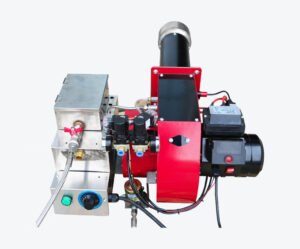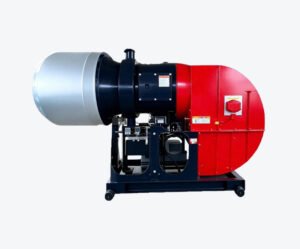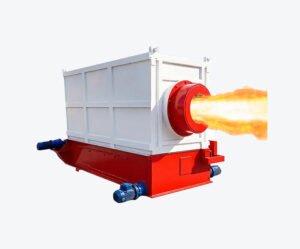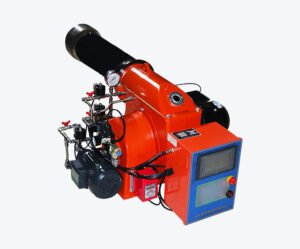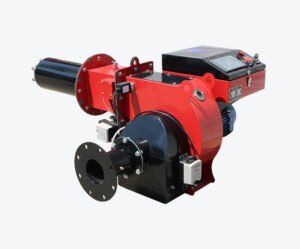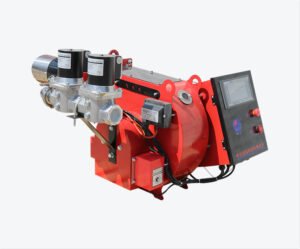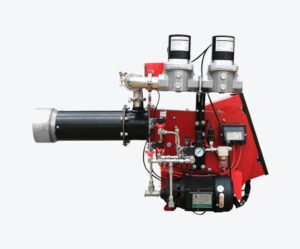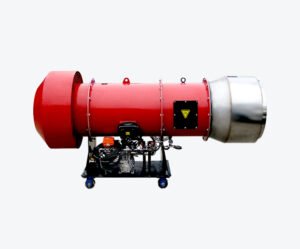
Features of Heavy Oil Burner:
1. Heavy oil burner.
2. Two-stage operation (high/low flame)
3. High pressure mechanical atomisation of fuel using nozzle.
4. Ability to obtain optimal combustion values by regulating combustion air and blast-pipe
5. Maintenance facilitated by the fact that the atomisation unit can be removed without having to remove the bumner from the
boiler.6. Minimum and maximum air flow regulation for first and second stage by means of electric servomotor with pause closure of gate to prevent any
heat dispersion to flue.
7. With the fuel pre-heater which installed with thermometer and adjustable temperature controller
8. One flange and one insulating seal for boiler fastening.
9. Combustion air intake with air flow adjustment device.
10. Adjustable blast-pipe with stainless steel nozzle and deflector disk in steel.
11. Three-phase electric motor to run fan and pump.
12. Flame presence check by photo resistance.
13. Electrical plant protection rating lp40.
Industrial burners using heavy fuels such as mazut, are extensively used in many heavy industries, including power plants, petrochemical facilities, and cement industries. Mazut-fired burners due to their high heat output and capability to operate at high temperatures, are suitable for long-term, intensive industrial processes. However, using heavy fuels requires specialized equipment, advanced combustion methods, and regular maintenance. This article explores different types of heavy fuels, their physical properties, and various combustion methods.
Pressure Atomization
Pressure atomization is a common method for converting liquid fuel into fine droplets in the combustion process. In this method, the fuel is subjected to high pressure (up to 25 bar) and passed through a small nozzle. As the fuel passes through the nozzle, its velocity increases, causing the fuel to break into tiny droplets. These fine droplets, due to their low pressure, evaporate and then mix with the combustion air for ignition. For optimal performance of this method, preheating the fuel to reduce its viscosity and ensure easy passage through the nozzle is essential. Additionally, providing high pressure plays a key role in producing uniform droplets and maintaining the stability of the atomization process
Air/Steam Atomization
Air or steam atomization is an efficient method for converting liquid fuel into fine droplets using a jet of compressed air or steam. In this method, the fuel is supplied at a lower pressure than in pressure atomization (typically up to 10 bar), while the air or steam is also supplied at a similar pressure (up to 10 bar). Inside the nozzle, both the fuel and air or steam pass through a small orifice, and the high shear force of the air or steam stream breaks the fuel into very fine droplets. These small droplets are evenly distributed throughout the combustion chamber, rapidly evaporate, and mix with the combustion air.
Air or steam atomization is a critical technique in the combustion process that helps improve fuel spray quality, increase combustion efficiency, and reduce pollutant emissions. This method is particularly effective for heavy, viscous fuels such as mazut and plays a crucial role in improving the efficiency of combustion systems.
Rotary Cup Atomization
Rotary cup atomization is an efficient technique for converting liquid fuel into fine droplets. In this method, fuel is introduced into a rotating vessel known as the “rotary cup,” which spins at high speeds. The centrifugal force created by the rotation causes the fuel to break into small droplets and be ejected from the cup’s edges. When the fuel exits the rotating cup, a high-speed air jet collides with the fuel stream, generating shear forces that break the fuel into even finer droplets.
The rotary cup method is effective for heavy fuels like mazut, as it breaks the fuel into fine droplets and, with the help of a high-speed air jet, facilitates better evaporation. Due to the impurities present in heavy oil, the rotary cup method helps avoid problems like nozzle blockages. However, it may result in the generation of higher pollutant emissions.
Compared to the other two methods, the rotary cup method requires more maintenance due to the use of electromotors and rotating components like belts and pulleys. These parts, operating at high speeds, are more vulnerable to damage and wear, which makes regular maintenance and repairs more necessary.
Boiler heavy oil burner application:
Mainly suitable for oil-fired boilers, industrial boilers, water heaters, steam boilers;
Food machinery hot air rotary furnaces, coating equipment, paint lines, paint stripping furnaces, textile machinery singeing machines, ironing equipment;
Road construction machinery; industrial kilns, ceramics All combustion heat equipment, such as equipment, has a very wide range of applications.